

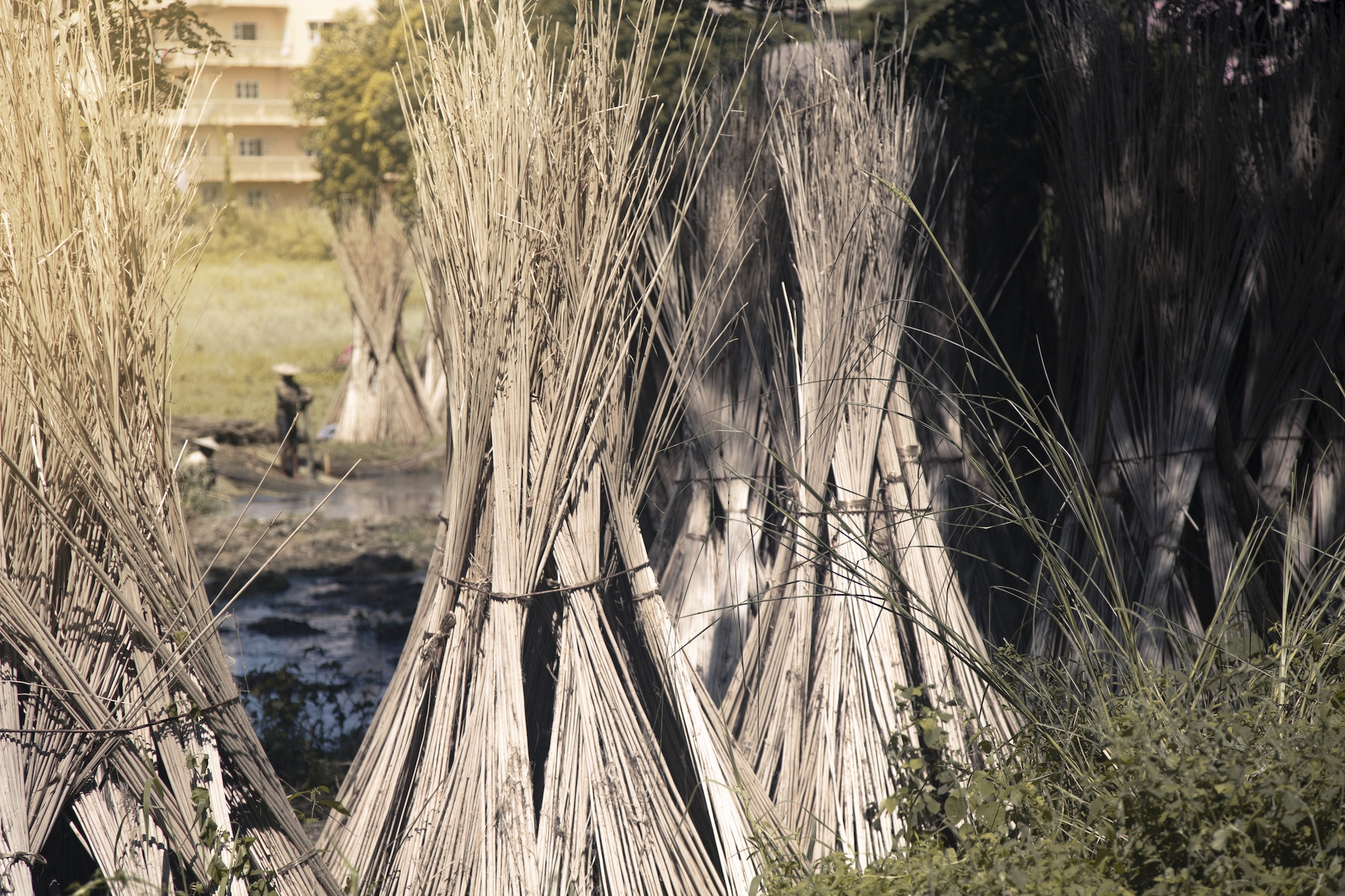
The plants are pre-grown and planted when they reach a height of 15 to 20 cm. After about four months, they can be harvested.
They are then roasted for 20 days before the fibers are separated by hand, washed in running water, and then dried. Before spinning, the fibers are treated with oil to make processing easier.
They are then roasted for 20 days before the fibers are separated by hand, washed in running water, and then dried. Before spinning, the fibers are treated with oil to make processing easier.
Jute fibers have a golden, silky sheen, which is why they are also called the "golden fiber." Jute takes dye well and is completely biodegradable. It has a high water absorption capacity, is moderately tear-resistant, and decomposes quickly. Its high tensile strength combined with low elasticity makes it suitable as an industrial yarn. Jute fibers look particularly impressive in our jute bags.
World production of jute fibers in 2007/08 was around 2.7 million tons. The largest producer was India (about 1.6 million tons), followed by Bangladesh (0.9 million tons) and other South Asian countries (Myanmar with about 0.04 million tons and Nepal with about 0.02 million tons). Global production fluctuates between about 2.3 and 2.8 million tons, cultivated on more than 1.3 million hectares of land.
After cotton, jute is the most important natural fiber in terms of quantity. Worldwide, 10 to 12 million small farmers make their living from growing jute, and many hundreds of thousands more from its processing. Most of the production is consumed in India and Bangladesh.
Jute outnumbers all other natural fibers used for technical purposes. In recent years, a wide range of new, high-value products made from jute fibers has been developed—home textiles, composites, geotextiles, paper, technical textiles, insulation materials, and, increasingly, fashion items and accessories.